
How High Should My Electric Standing Desk Be?
Dickson LamYour electric standing desk should be at elbow height, so your elbows form a 90-degree angle while you type and the top of your monitor sits at or slightly below eye level. For most adults that means a standing desk height of about 38" to 44", and a sitting height of about 23" to 28".
People across Canada choose standing desks to create healthier, more active workspaces, and the most common question afterwards is how high to set them. Desk height has a big effect on your comfort: set it right and you barely notice it; set it wrong and your neck, shoulders and wrists let you know.
This guide gives you a height chart, a quick elbow check you can do in 30 seconds, and the monitor and accessory adjustments that go with it.
How High Should a Standing Desk Be for Your Height?
A standing desk should be about 36" to 38" high for someone 5'0", 38" to 40" at 5'4", 41" to 43" at 5'8", 43" to 45" at 6'0" and 46" to 48" at 6'4", measured from the floor to the top of the desk.
The chart below uses the suggested ranges from Inch Calculator's desk height chart, the same tool behind our desk height calculator. Monitor heights are to the top of the screen.
|
Your Height |
Standing Desk Height |
Monitor Top (Standing) |
Sitting Desk Height |
Monitor Top (Sitting) |
|---|---|---|---|---|
|
5'0" |
36" to 38" |
55" to 57" |
22" to 24" |
41" to 43" |
|
5'4" |
38" to 40" |
59" to 61" |
23" to 25" |
44" to 46" |
|
5'8" |
41" to 43" |
63" to 65" |
25" to 27" |
47" to 49" |
|
6'0" |
43" to 45" |
67" to 69" |
26" to 28" |
49" to 51" |
|
6'4" |
46" to 48" |
71" to 73" |
28" to 30" |
52" to 54" |
Treat these as starting points. Your arm and leg proportions, your chair and your shoes all shift the ideal number by an inch or two. The Nimble, Terra, Wildwood and Grove desks adjust from 23" to 50", which covers every standing height in this chart.
How Do You Find Your Perfect Standing Desk Height?
Find your perfect standing desk height by standing with your shoulders relaxed, bending your elbows to 90 degrees and raising the desk until its surface sits just under your forearms. Then set your monitor so the top edge is at eye level.
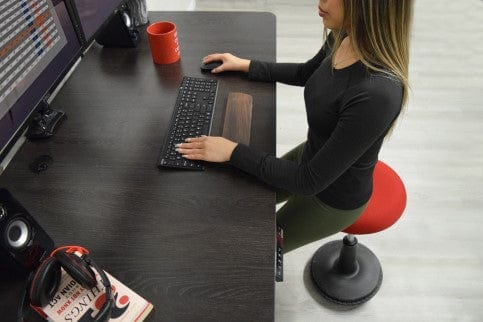
The Elbow Check
Your arms should form a right angle at the elbow when you type. This 90-degree angle is your starting point for an ergonomic workspace.
Place your hands on your keyboard while standing. Your forearms should be parallel to the floor with your shoulders relaxed. In this position you can type without bending your wrists or pressing your forearms into the desk edge.
For most people, this puts the desktop around 38 to 44 inches from the floor when standing, though your exact height depends on your body proportions. Your shoes can also change the right height by an inch or more, so set the desk in the shoes you usually wear.
Learn more tips on how to avoid computer elbow pain here.
Stand Tall, Feel Great
A common mistake is setting the desk too low, which makes you hunch. Your shoulders roll forward and your upper back rounds to reach the keyboard.
Your height-adjustable desk should let you stand upright with a balanced posture. Keep your back straight but not rigid, your knees soft and your weight spread evenly over both feet. Many people find that an anti-fatigue mat helps them hold this position for longer.
To get the most from your standing desk, switch between sitting and standing through the day. Changing position keeps you moving and helps you avoid the stiffness that comes from staying in one posture for hours.
Your height also affects your standing posture. Tall people tend to slouch forward if the desk is too low, which is why they need a tall standing desk with a high maximum height. Shorter people need a desk that goes low enough, and a short standing desk saves them from reaching up and straining their necks.
If you're unsure how high your desk should be, use our desk height calculator to get measurements for your body, shoes and chair.
Keep Your Neck Happy

The neck is especially vulnerable to a badly placed screen. Your monitor position matters as much as your keyboard height.
Your screen should sit at eye level so you can look straight ahead with a neutral neck. If you have to tilt your head up or down to see it, you risk neck pain and eye strain.
For most people, the top of the monitor should be at or slightly below eye level, about an arm's length away. Because your eyes are much higher when you stand, the monitor needs to rise with you: a monitor arm makes this easy, and it is close to essential if you work from a laptop.
Use the monitor columns in the chart above as starting points, then make small adjustments until your neck feels relaxed.
Adapt Your Setup With Accessories

Adding accessories to your electric standing desk can improve your workspace, but remember to adjust your desk height to match.
If you add a standing mat, casters or a thick desk pad, raise the desktop slightly to keep your 90-degree elbow angle.
A keyboard tray can create the ideal typing height while freeing up desk space. If you use one, you may need to raise the main desk surface so your monitor stays at the right height.
The Nimble, Terra, Wildwood and Grove desks have 4 memory presets, so you can save your sitting and standing heights once and switch between them with the push of a button.
Frequently Asked Questions
How do I find my exact standing desk height?
Measure from the floor to the underside of your forearm while you stand with your elbows bent at 90 degrees, wearing your usual shoes. That number is your desk height. The effydesk desk height calculator works it out from your height if you prefer not to measure.
Should shorter people use different desk heights?
Yes. Desk height should match each person's body, and shorter people need a lower setting both sitting and standing. A desk that goes down to 23", like the Nimble, Terra, Wildwood and Grove, suits most people from about 5'0" upward when seated.
How often should I switch between sitting and standing?
A common starting point is to stand for part of each hour and build up based on comfort. Regular changes of position matter more than long stretches of standing, which can tire your legs.
Can the wrong desk height cause health issues?
Yes. A desk that is too high or too low keeps your shoulders, neck and wrists in awkward positions, which can lead to discomfort and strain over time. Setting the right height for both sitting and standing is one of the simplest ways to lower that risk.
What is the standard height of a regular desk?
Most fixed desks are 28" to 30" high, which suits a seated adult of average height or taller. Shorter people often find that too high, which is one reason an adjustable desk helps.
Support Your Workday With the Right Height
Finding your ideal height for both sitting and standing makes a real difference to your daily comfort. The 23" to 50" range of effydesk's Nimble, Terra, Wildwood and Grove standing desks gives you room to set up a workstation that fits your body.
Your body may want slightly different heights through the day. Listen to what feels comfortable and adjust as you go.
Ready to upgrade to a standing desk that fits you? Browse our height-adjustable desks, with frames in several colours and a choice of desktops to match your office. Every desk has a 20-year warranty on the frame, motors and electronics and a 100-day trial.